
Fragrance Oil Calculator for Candles
Enter your wax weight and fragrance load, and the calculator gives the exact amount of fragrance oil in ounces and grams — plus how to split it between scents in a blend and what the fragrance costs per candle.
- Free to use
- No sign-up
- Runs in your browser
Calculate fragrance oil
Candle Fragrance Blend Workbook
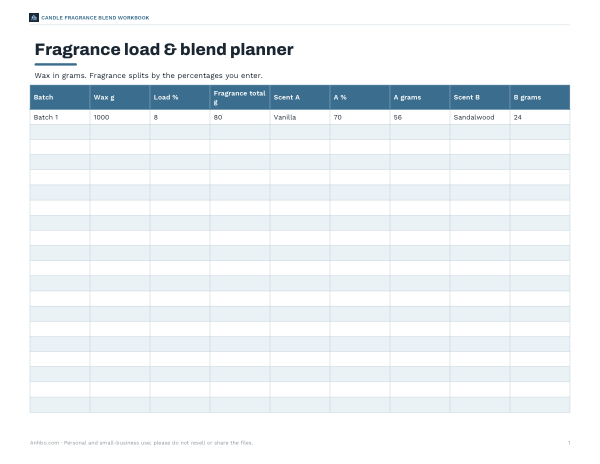
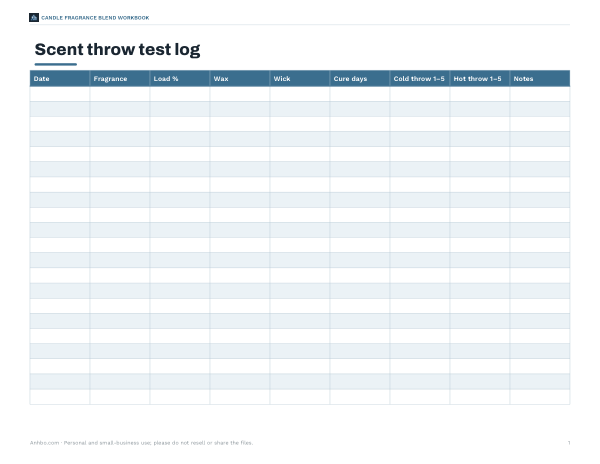
Fragrance load and blend calculator for every batch, a fragrance inventory and a scent throw testing log.
- Fragrance load & blend workbook (XLSX, PDF)
- Scent throw test log (PDF, DOCX, XLSX)
- Fragrance inventory (XLSX)
Formats: XLSX, PDF, DOCX. Instant download after payment (link valid 72 hours, up to 5 downloads). AI-assisted: the templates were drafted with AI help and reviewed and laid out before publishing.
$4.00 USD, one-time 3 files · about $1.33 each
- Instant download
- 7-day refund
- Secure checkout by Stripe
7-day money-back guarantee. Full refund within 7 days of purchase, even after you download.
Full refund within 7 days — see the refund policy and license.
Free printables
Single sheets you can print right now, no sign-up. The full pack adds every sheet in one download plus the editable files.
How fragrance load works
Fragrance load is the amount of fragrance oil added to wax, expressed as a percentage. Candle makers and suppliers most often calculate it as a percentage of the wax weight: 1 pound (16 oz) of wax at an 8% load takes 1.28 oz of fragrance. Weighing both wax and fragrance on a digital scale is essential — fragrance oils have different densities, so measuring by volume with spoons or cups gives inconsistent results.
- Fragrance weight = wax weight × fragrance load ÷ 100.
- Per pound of wax: 6% = 0.96 oz, 8% = 1.28 oz, 10% = 1.6 oz, 12% = 1.92 oz.
- In grams: 454 g of wax at 8% = 36.3 g of fragrance.
What load should you use?
Most container waxes are designed to hold somewhere around 6% to 12% fragrance, and each wax has a maximum stated by its manufacturer. Fragrance oils also have recommended maximum usage rates for candles. Use the lower of the two limits. Many makers start around 6–8% for soy and coconut blends and adjust after test burns. A higher load does not guarantee a stronger scent: throw depends on the fragrance, the wax, the wick, the container and the cure time.
| Load | Per 16 oz wax | Per 454 g wax | Notes |
|---|---|---|---|
| 6% | 0.96 oz | 27 g | Light to moderate; good starting point |
| 8% | 1.28 oz | 36 g | Common choice |
| 10% | 1.60 oz | 45 g | Near the maximum for many container waxes |
| 12% | 1.92 oz | 54 g | Only if the wax and fragrance allow it |
Worked example
You are making two 8-ounce candles, so you need about 16 ounces of candle blend. With 16 ounces of soy wax at 8%, you add 1.28 ounces (36.3 g) of fragrance oil. If you blend two scents 60/40, that is 0.77 oz of the first and 0.51 oz of the second. At $2.20 per ounce of fragrance, the fragrance costs about $1.41 per candle.
Adding fragrance at the right temperature
Wax and fragrance bind best when the fragrance is added to hot, fully melted wax. Many soy wax suppliers recommend adding fragrance at about 185 °F (85 °C), then stirring gently but thoroughly for one to two minutes. Adding fragrance to wax that is too cool can lead to oil separating or sweating on the surface; adding it much hotter than recommended can cause some of the lighter aroma notes to evaporate. Always follow your wax's technical data sheet.
Flash point and safety
The flash point of a fragrance oil is the lowest temperature at which its vapour can ignite with an open flame. It is a shipping and handling safety figure; in practice, fragrance is added to wax below the boiling points involved in cooking, and flash point does not tell you how the scent will throw. Still, keep melting wax away from open flames, never leave it unattended, and store fragrance oils sealed, away from heat and out of reach of children. Some essential oils and fragrance components are skin sensitisers, so wear gloves when handling concentrated oils.
Blending fragrances
Blending two or three fragrance oils creates custom scents. Keep the total fragrance at your chosen load and divide it by percentage: a 70/30 blend of vanilla and sandalwood at 8% in 16 ounces of wax is 0.90 oz vanilla and 0.38 oz sandalwood. Mix a small test blend on a paper strip first to check the balance, and note the exact ratio so you can repeat it. Some combinations change colour over time — vanilla-containing oils, for example, can discolour wax to tan or brown.
Getting a stronger scent throw
- Let candles cure — often one to two weeks for soy — before judging scent throw.
- Use the right wick size so a full melt pool forms within a couple of hours.
- Choose fragrance oils rated for candles and your wax type.
- Stir fragrance in thoroughly at the recommended temperature.
- Test at different loads and keep records.
- Store finished candles with lids on, away from heat and sunlight.
Keeping batch records
Consistent candles come from consistent records. For each batch, write down the wax and its lot number, the fragrance oil and supplier, the load, the temperature at which fragrance was added, the pour temperature, the wick, and the cure time. When a batch performs especially well — or badly — the notes show exactly what to repeat or change. The paid workbook includes a batch log that calculates fragrance weights and cost for you.
Frequently asked questions
How much fragrance oil per pound of wax?
About 1 oz at 6%, 1.3 oz at 8% and 1.6 oz at 10%.
Is fragrance load a percentage of wax or total weight?
Most suppliers and makers use percentage of wax weight, which this calculator uses.
Can I use more than 10% fragrance?
Only if both the wax and the fragrance supplier allow it. Too much oil can seep and burn poorly.
At what temperature should I add fragrance oil?
Follow your wax data sheet; many soy waxes recommend around 185 °F (85 °C).
Why does my candle not smell strong?
Common causes are too short a cure, the wrong wick, adding fragrance at too low a temperature, or a fragrance that does not throw well in that wax.
Should I measure fragrance oil by volume?
No, weigh it. Fragrance oils vary in density, so volume measurements are inconsistent.
Can I add fragrance to wax melts at the same rate?
Wax melts often use similar or slightly higher loads, within the wax and fragrance maximums; check your wax data sheet.
Does dye affect how much fragrance I can add?
Dye does not change the calculation, but some dye and fragrance combinations affect burn and colour, so test together.